
Thursday, October 9, 2014

Tuesday, October 7, 2014
Modern Mythology

Today was the big release day and I went to B&N to pick up an armful of books around 9:30 (over an hour after a student had already asked for the book). I wasn't all that excited until I came upon the Riordan table, with a book spread like a Thanksgiving feast! Everything from graphic novels to mythology books were piled deliciously high. The store had only been opened thirty minutes and they were already having to replenish the supply.
Suddenly, I realized this is a big deal. Sure, it's just the most recent release of a teen author, but the fact that people, kids at that, are still buying and checking out books, not only in e-format, but in print, is noteworthy.
Though, I'm a proponent of reading in any format, I think the idea that print should be done away with entirely is short-sighted. The electronic format is not preferred or economically viable for all and that includes the younger generation.
Pew backed up this idea with research findings discussed in"Younger American's Library Habits and Expectations" in which they noted that Americans under 30, "are now significantly more likely than older adults to have read a book in print in the past year (75% of all Americans ages 16-29 say this, compared with 64% of those ages 30 and older). And more than eight in ten (85%) older teen ages 16-17 read a print book in the past year, making them significantly more likely to have done so than any other age group."
This could be explained away by saying they are required to read for school, but I know plenty of kids (and adults) that don't complete required reading. One could also say that they simply have more financial constraints and must checkout print rather than purchasing eBooks. Yet, both formats are made available by libraries, so that doesn't quite work. Why not, instead, accept the facts at face value: young adults read a lot in a variety of formats.
Pew also noted that the younger crowd has, "a broad understanding of what a library is and can be-a place for accessing printed books as well as digital resources, that remains at its core a physical space." Maybe, we should all take a queue from Riordan, who makes modernizes mythology in his books, and realize that we too,young or old, can have the best of both worlds: print and electronic/ physical library and virtual library.
Works Cited
Zickuhr, Kathryn, Lee Rainie, and Kristin Purcell. "Younger
Americans' Library Habits and Expectations." Pew Internet and American Life Project. Pew Research Center, 25
June 2013. Web. 7 Oct. 2014. <http://libraries.pewinternet.org/2013/06/25/younger-americans-library-services/>.
Wednesday, September 24, 2014
Guns, Germs, and Steel: The Fates of Human Societies, by Jared Diamond

If there's one good thing about a long commute, it's having plenty of time to listen to audiobooks. When it comes to nonfiction texts, like Guns, Germs, and Steel, I often find my mind wandering as I turn the pages. Thus, the audiobook option for this chunk of a book was perfect.
Diamond is possibly one of the most methodical writers I've encountered. He lays out the book, chapters, and paragraphs as if he's charting a conquest himself. Not only does he tell you what he will be discussing in the coming pages, but summarizes what he has discussed a the end...such a teacher.
This epic journey through time and the rise and fall of peoples around the world is spurred by a friend in New Guinea wondering why his people are behind Westerners. Diamond speculates that these people are actually more intelligent that the average Westerner. He uses this as his reference point throughout the book. The main areas of focus are the domestication of food and animals, the diffusion of information, the migration of people, and the variation in population numbers, location, and mindset.
I'm not a huge history buff, so a lot of the information was new to me. A few standouts:
- The theory that Eurasia developed faster than the Americas, because the continent is longer East to West rather than North to South. Therefore, since more land is along the same latitude, the knowledge of how to domesticate crops and animals spread faster.
- A number of people adopted and then abandoned certain tools, weapons, and modes of transportation. This was interesting, given the current state of the world where everyone is always looking for the next best thing. Also, it made me think of the Amish.
- Most diseases that wiped out massive amounts of people originated from people living in such close proximity to livestock and their own filth. Europeans were among the first to domesticate animals and live sedentary lives. A lot of them died, the ones that survived were immune, and those same diseases wiped out people without the immunity.
Long story short, the people that are the best off in the world came by it due to circumstance, not because they are smarter.
Thursday, September 18, 2014
The Brief Wondrous Life of Oscar Wao, by Junot Diaz

Love isn't easy to come by when you're an overweight nerd like Oscar, but it's even more rare when you have fukú to deal with. The friendly narrator in The Brief Wondrous Life of Oscar Wao, who has such a conversational tone that you feel like you've been sitting on his couch listening to the whole story in person, introduces us to history of this curse. We learn that it made it's way to the Dominican Republic and surrounding islands with the Europeans and cuddled up with the dictator at the time, known as Trujillo, who killed, raped, and doomed thousands of families to endure the wrath of fukú.
Oscar is part of one such family and the story of each of its members is told from their perspective. We learn of Lola's trials with her hateful mother and being sent back to the DR to spend time with her grandmother. Beli, Lola and Oscar's mother, is tough as nails and mean to boot as a result of the death of both of her parents, abuse, and betrayal. Her saving grace was La Inca, her aunt and adoptive mother, who is the glue that holds the family together. Then, there's Yunior, who is revealed as the narrator partway through the book. He was Oscar's roommate at Rutgers and dates Lola for a few years before his cheating ways finally catch up with him.
As the stories of these characters and many more are told we begin to realize that fukú is truly inescapable. It's something beyond this world that lives in the fantastical realm that determines one's fate before they are even born. Diaz brings mythology into the modern day with his magical way of melding history, reality, and mysticism; all held together with a spattering of expletives.
Friday, September 12, 2014
The Book Whisperer, by Donalyn Miller
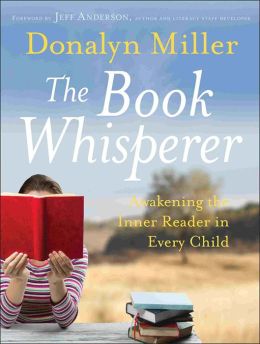
With the 40 book challenge well under way, it's about time I finished The Book Whisperer, by Donalyn Miller! I've never taught English Language Arts or Reading before, but I would say anyone who is, has aspirations of doing so, or works with those that do (librarians) should take the time to flip through the pages of this book.
Miller draws a great deal from her own experiences and practices while weaving in research and findings from scholars in the education field. There is no denying her passion for igniting a passion in every student to not only read in her class, but continue to devour books long after they leave her room. Miller discusses how reading is not only a proven way to perform better on tests, but to connect with students and friends, stating, "If I have ever brought you a book unasked for, know that I cared. I said everything to you that I wanted to with that book" (172).
As teachers, we (maybe it's just me) often think that we aren't doing our job properly if we aren't at the front of the class talking away. To allot large chunks of time for reading seems lazy(?), but Miller assures us that this is time well spent. This is time that the instructor can use to meet with students, read their journals, or read themselves in order to better recommend books to students with any and all tastes.
I know that this a book I will reference for years to come and I can't wait to crack open her most recent book, Reading in the Wild!
Wednesday, September 10, 2014
The Amazing Adventures of Kavalier & Clay, by Michael Chabon

The Amazing Adventures of Kavalier & Clay, by Michael Chabon, brought the idea of destiny to my mind time and again. Though, Chabon never says outright that it was fate that Josef (Joe) Kavalier and Sam Clay's lives merged at just the right time, it's understood. Maybe, it's because the circumstances that brought the two together were wrought with life-altering heart-ache that "destiny" doesn't seem quite appropriate.
Their journey begins as Hitler is taking over in the late 30's and Joe miraculously makes his way out of Prague and to the warm bed of his cousin, Sam. At 19, Joe has left behind his entire family and his only chance at a livelihood is his art, which he has been honing at the Art Institute in Prague. Sam, who has been working for Empire Comics, wastes no time teaching Joe the way of comics. Soon, the two concoct the storyline and artwork for the first comic featuring the Escapist. A superhero fashioned after Houdini that is able to outwit the Nazis time and again.
The Escapist mirrors Joe's own life, featuring the Golem, which Joe actually had a hand in saving from Prague. Also, Joe practiced magic under the tutelage of a famous magician, Bernard Kornblum. As the story progresses Joe and the Escapist blend into one. In the beginning, Joe refuses to perform magic, stating that his best magic trick was making it out of Prague. As time goes by, he starts performing at Bar Mitzvahs and manages to keep a man from detonating a bomb and eventually sets his mind to bungee jumping from a building; like a superhero or a Dad trying VERY hard to impress his son might do.
During this transformation, Joe falls deeply in love with a fellow artist, Rosa, who he leaves with child, unbeknownst to him, to join the Navy in order to "kill the Nazis" after the ship carrying his younger brother and hundreds of other refugees is bombed. Sam, whose lovely companion Tracy Bacon is killed in the war, marries Rosa to save face and raises Tommy as his own until Joe reappears twelve years later.
This is a masterful work that connects historical events, art, comics, love, loss, religion, and fantasy in such a way that you can only pick your jaw off the ground and grin.
Friday, September 5, 2014
The Fire Within, by Chris D'Lacey

The Pennykettles, Liz and her daughter Lucy, are eccentric to say the least. Liz spends her days making clay dragons while Lucy spends hers chasing after an injured squirrel. David is soon wrangled into the search and inspired to write a story about a squirrel named Snigger. Meanwhile, he's becoming more closely acquainted with the dragons of the house; especially the one that has a penchant for stories, named Gadzooks.
Oddly enough, their real lives begin to look a lot like the David's story and the lines between reality and imagination begin to blur as David's learning goes beyond his college work and into the fantasy land of dragons.
I've wanted to read The Fire Within series for a while, now, since I see the kids check it out year after year. I'm not sure that I'll make it through all seven any time soon, but I can now recommend it from first-hand-experience rather than the fact that it's popular. D'Lacey makes what could possibly be a very silly story about clay dragons into an endearing quest bouncing between this world and those only imagined.
Subscribe to:
Posts (Atom)